We come to this joint piece as two Indigenous Pacific women who have been entangled with the colonial legacies and politics of German and European museums, as we work to engage in rematriation, or practices of care, reclamation, and restorative justice for our ancestors who were wrenched from our homelands and are now held within these institutions. We first met in Paris at a seminar day organized around the theme of “Museum Orders, Epistemic Disorders: Documenting Tensions” at the Ecole normale supérieure. This article grows from our seminar presentations, and conversations that we’ve had with each other since, as we work to locate and care for our dispossessed ancestors within the bowels of German museums.
As scholar researchers from the Mariana Islands, and Sāmoa, our article is situated in the Pacific context. The Pacific covers more than a third of the world’s surface and is home to the majority of the world’s islands, including the Mariana Islands and Sāmoa. Sāmoa, officially the Independent State of Sāmoa, is part of the Sāmoa archipelago located near the middle of the Pacific, and has a population of over 218,000. Historical milestones that shaped the nation includes the introduction of Christianity led by Reverend John Williams of the London Missionary Society in (1830), the colonial administrations of Germany (1899) and New Zealand (1914), and Sāmoan independence (1962).
Located in the Western Pacific region of Micronesia, the Mariana Islands are the homelands of the indigenous Chamorro and Refaluwasch people. In Samantha’s section, she discusses the importance of Indigenous interventions in colonial collections as a practice of care and liberation.
In the following piece, we weave together our struggles navigating European museums, and examine how politics of Indigenous-led rematriation can intervene in the disordered and violent legacies of ethnographic museums. In this piece, we explore the following questions: Is it possible for rematriation to be in research engagement with institutions? How can rematriation respond to disorder?
In 1988, Sto:lō scholar Lee Maracle introduced the term and concept of rematriation. At this point, rematriation had surfaced primarily as a concept to restore and reclaim matriarchal responsibilities in Indigenous infrastructures (Maracle 1988). In the 37 years since, rematriation has been re-interpreted, adapted and implemented in varying ways across different sectors, communities, and spaces, but remained firmly in the notion of reclaiming and reconciling indigenous ways of knowing, seeing and being. A very concise statement by Robin R. R. Gray serves as the basis for our exploration of rematriation, which is “both a turn away from the colonial order of things and a turn toward Indigenous nationhood” (Gray 2022). In this piece, we center rematriation as an Indigenous practice, one that is urgently necessary as we grapple with the politics of ethnographic museums.
Hawaiian scholar Hi’ilei Julia Kawehipuaakahaopulani Hobart notes that Indigenous studies and Black studies employ haunting as a “conceptual framework for understanding the phenomenological weight of settler colonialism and racial capitalism” (Hobart 2024, 396). Theorizing museum collections as haunted firmly situates them as sites of violence, and as the aftermath of colonial mechanisms of death which pervade the institution and muddy its attempts to position itself as an apolitical or neutral space. Engaging with haunting as a theoretical framework for museums allows us to analyze how the presence of my ancestors within these institutions summons the histories of colonial occupation as material realities that are never fully past. Examining the museum as a haunted space is also an apt framework for examining how these institutions attempt to sanitize their collections—both through the literal process of preservation, which renders cultural belongings into objects and artifacts whose meaning is transformed once they are separated from their communities, and through discursive attempts to position themselves as benevolent purveyors of culture. Rematriation, in turn, is a movement towards reclamation which acknowledges the violence of the museum.
Ruby Satele
Compelled by the themes of the ENS workshop, I started to ponder deeply on epistemic disorder and couldn’t shake the thought of the dynamics of power in institutions. The link between epistemic disorder and power dynamics is compounded by my recent interactions with museums in Germany. I would be remiss if I neglected to mention that with concern of epistemic disorder, communities are often sidelined. The most severe breach to Indigenous epistemologies is perhaps the collecting of ancestors’ bodies in museums and tertiary collections. Being in institutions even now is a continuum of these breaches or disorders. With each thought of epistemic disorders or power dynamics, however, it would always be followed by interventions through the key involvement of communities. Maybe I don’t want to stay in these positions of “disadvantaged” and want to think of a better future. Dealing with harm and violence means to sit with your grief but also being able to turn this into a foundation to build resistance, resilience, self-determination, and healing. One of the ways that I choose to do this is through the conceptual framework of rematriation. I bring to focus the institutionalization of Sāmoa ancestors in Germany, the process of my research inquiry into this, and the inherent nature of rematriation.
For the purpose of this article I situate how the ideas and practice of rematriation is mobilised within Sāmoa epistemology to confront the power dynamics concerned. In the midst of figuring rematriation in Sāmoa epistemology, the fanua (land) stands out as a salient domain of power. Fanua is vital to our identity and livelihood, as it is not just pieces of land, but rather a foundation of all things pertaining to our culture. Together with the ocean and the sky, the land is significant to our ontology, cosmogony and epistemology. We care for the fanua and the fanua care for us. Aiga (kin, family) have mostly maintained full customary ownership of their fanua in the face of colonial and imperial subjugation. If grounded in fanua, then rematriation is practical, theoretical, spiritual, and regenerative. Therefore, in this piece, as well as in my wider research practice, fanua-based rematriation is my terminus a qui. It provides a crucial point of entry into the scholarship of decolonisation and in the words of Robin R. R. Gray “a turn toward Indigenous nationhood” (2022).
A growing yet underdeveloped area of museum practice involves the inquiries and initial communications initiated by communities themselves. The dynamics of power and authority that shape access to collections are rarely examined or openly discussed. In the following section, I explore an inquiry that occurred more than a century ago, alongside my own experiences engaging with museums.
At the turn of the 20th century, a traumatic event unfolded with the removal of skulls belonging to Sāmoan ancestors during the period of German colonial rule in Sāmoa. In Matatufu village, in the south east coast of Upolu, Samoa, Fa’atili, a local chief, was on this ocassion a guide for German colonial administrator Erich Schultz (also known as Erich Scultz-Ewerth). Schultz- was known for his familiarity with fa‘asāmoa—the Sāmoan way of life—and the Sāmoan language. He also bore the mālofie, the distinguished tatau (tattoo) that signifies high status within Sāmoan society. As he and Fa’atili were moving through abandoned areas of Matatufu they came across skulls that were partly buried (Schultz 1926). Defying his knowledge of fa’asāmoa and against the behest of Fa’atili, Schultz later masterfully stole the ancestors’ skulls and shipped them to the Director of the Ethnological Museum in Berlin, Felix von Luschan. Believing that he succeeded without anyone finding out, he was shocked to receive a letter from Fa’atili. In this letter, Fa’atili informs Schultz that he knows what he has done with removing the skulls, which has brought deaths for many of his relations and he, himself, had also become severely ill consequently. Fa’atili pleaded vehemently for the ancestors to be returned to lie where they were. In a panic mode, Schultz writes to Luschan to return the skulls. After some back and forth, Schultz and Luschan agree to “return” skulls of other peoples as a decoy. The correspondences seemed to end there, and it remains a mystery as to what happened to the skull that were sent as replacements
Fa’atili’s request is one of if not the earliest claims for ancestral remains made to Germany, and to this day, the first and last from Sāmoa. He confronted and implored Schultz for the return of ancestors, effectively using his agency to challenge the dominant power. As we learn, Fa’atili’s request might have been successful had it not been for Luschan who was adamant not to waste his efforts in mounting the skulls. But what takes place instead is precisely epistemic disorder, when he discounts Fa’atili’s relational knowledge of the ancestors and asserts his own as the more plausible. This reflects a collision of worldviews and ethics, and the imbalance of power seen in both the removal with Schultz and its further perpetuation by Luschan’s retention of the skulls. In the end, the skulls of the ancestors were never returned and are currently in the Pre- and Early History Museum of Berlin.
Similar power dynamics are still seen today. Communities seek understanding, answers and a host of things that museums hold and while these can be met, the trajectory to arriving to such a point is not always without a play of power dynamics. To discuss this in a contemporary context, I highlight a process of inquiring about access to collections. My research is centered on the ancestors and it requires personal visitations; therefore, contacting, communicating and making arrangements with museums is necessary. This has, in a few instances, uncovered confronting power dynamics with institutions. This is projected in various ways, which includes, inquiries that remain unanswered, requiring multiple “follow-up’s”, or when responses are lengthy or circuitous without agreeing to your request or just to inform you that they are busy, or they reschedule multiple times due to their scheduling until you realize there is no real effort to make accommodations. Perhaps the most unpleasant experience is when you are asked, in an uninviting manner, to justify why a visit is necessary. Indeed, I take into consideration other factors such as under-resourcing and scheduling conflicts. Although these are initial experiences, it seems recurring as I come across many powerless situations of people and ancestors in my research and in lived experiences. Museums must realize that it is already paternalistic that communities must ask to view their cultural heritage or ancestors in institutions. Institutions continue to occupy the ballpark, as every key decision rests on them. Therefore, it is critical that museums operate in ways that share authority and power as much as they can. These cases illustrate how the inquiry process intersects technical, legal, custodial, and political dimensions, revealing power dynamics that can marginalize both indigenous communities and scholars seeking to engage meaningfully with ancestors and material culture. In spite of these challenges, well-meaning correspondence between museums and communities creates an energetic and rewarding experience for those involved.
Upon finding out the possibility of a Sāmoan ancestor in the GRASSI Museum in Leipzig, Germany, I contacted the staff in charge through e-mail, explaining my background and my research inquiry and purpose. She responded with genuine gratitude that we were in contact and explained that she will put together a list for me, acknowledging it would take some time, and gave a rough estimation of when I can expect the list. She also asked about my supervisors and their institutional affiliation so that they would be prepared to communicate with them if needed. This was a fair request and I replied accordingly. As we were corresponding during the European ‘summer period’, a period when many people are away from the office, I had to follow up on an unanswered email one time - which was to be expected - in which we were able to confirm a date.
On October 25, 2024, I arrived and met with her and a student intern in the office to discuss my project and their holdings. They took me to their multi-functioning community hosting space called the ‘Room of Rememberance’ where the ancestor and other materials awaited. She introduced me to the space, showed me the materials and finally the ancestor, and then said to take all the time I need to be with the ancestor while she waits nearby. I did visual inspection and took research notes, and the rest of the time I spent with the ancestor, talking, singing, listening to Sāmoan music and pondering about many things. Hours later, I informed the staff that I was finished; she and the intern rejoined me as I wrapped up my visit. I ‘wrapped’ the ancestor with lace, laid a ula or lei (neck garland) above that, before the lid was fitted on the packing unit. Finally, I said my lotu fa’amavae (farewell prayer). Our correspondences, in email and in person, emanated understanding, solidarity, and the museum’s curator’s willingness to accommodate and make space and time for me. This engagement was deeply meaningful; the impression stayed with me for a time, and I felt the capacity to continue exercising my agency, starting from my inquiry. By enabling community members and researchers to take charge of the engagement, the power is distributed to the people whose stories are represented, drawing out meaning and reigniting emotional and spiritual connections. Whether we acknowledge it or not, museums hold power through legal ownership and custody of collections, including ancestors, and it is only through the staffs time, efforts, and willingness that community visits are made possible.
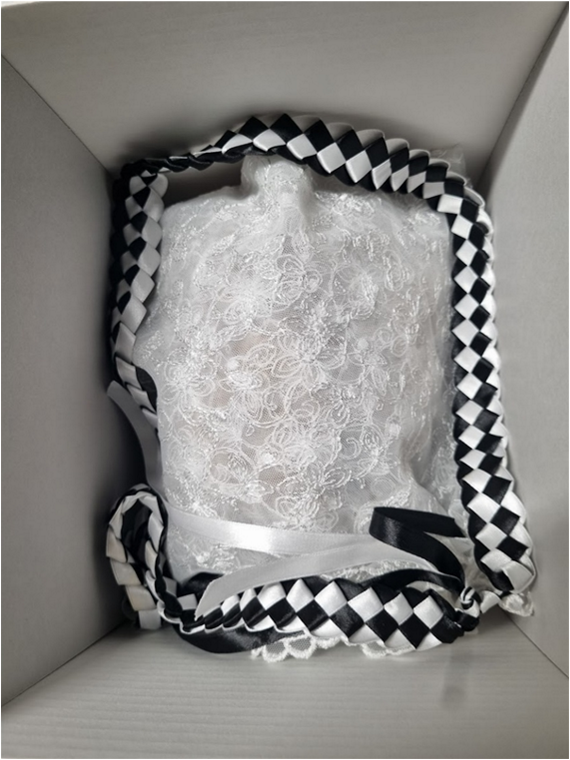
Fig. 1. Lace and lei coverage for an unidentified Samoan ancestor in Grassi Museum, photography by Ruby Satele, 2024.
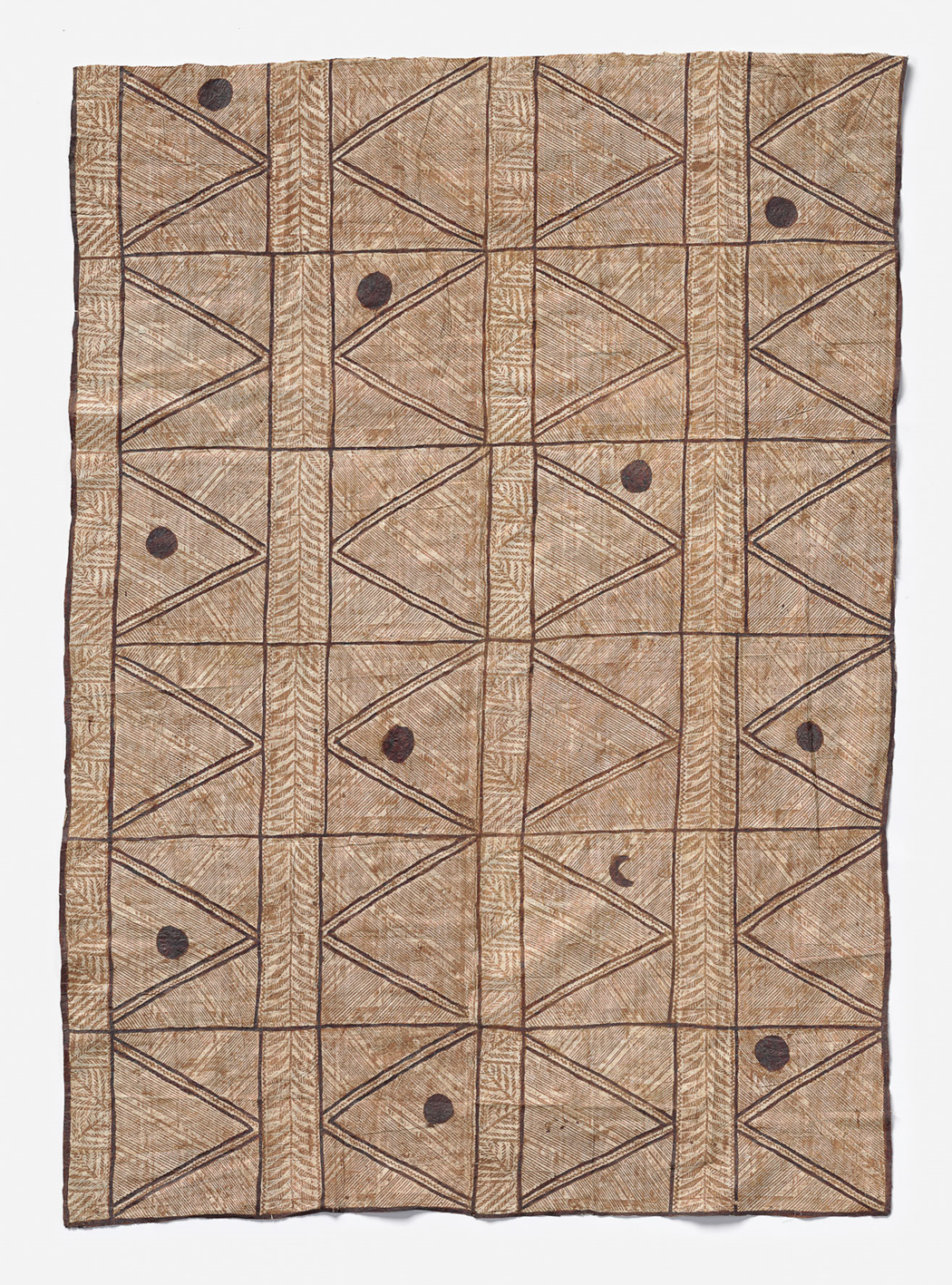
Fig. 2. Siapo, Ethnologisches Museum, Berlin, inv. VI 21625, courtesy of Museen zu Berlin.
Museums are not a neutral container, but generators of meaning (Griesser-Stermscheg 2013). Communities play a prominent role in realizing these meanings through close engagement. By implementing practices of the land or culturally specific protocols, the severed connection between the ancestor and fanua begins to be re‑established by the community inside museums. Power dynamics will shift and become distributed and shared across both the museum and community. Such is the case with my implementation of the customary practice of enclosing the ancestor with lace cloth inside museums called ufimata (ufi is to cover and mata is eyes or face).
The white cloth, typically lace or stain, has increasingly become a counterpart to siapo (tapa) in Sāmoan funerary. It surfaced as a substitute for siapo when in the diaspora siapo was not readily available for carrying out cultural customs. Today, white cloth is regularly, if not singularly, used together with siapo. It carries the same principles that siapo stand for, in caring for the dead. The siapo is a distinctive textile in Sāmoa made from u’a (paper mulberry tree, Broussonetia papyrifera), otherwise known in the English and French language as tapa, and “Rindenbaststoff” in German. Its role is significant in the continuity of customary and art practices and in adorning and safeguarding bodies. Its lifespan begins and ends in the fanua, rising through harvest and setting permanently by returning to the fanua. From a strictly customary point of view, this lifespan is simplified in the following: the u’a is harvested from the ground and transformed into siapo by the hands of siapo makers, it then circulates as an agent of relationships in customary and ceremonial practices, before its becomes ufimata and encloses the body of the deceased and together return to the fanua.
Sāmoan epistemology reveals that the siapo life trajectory is parallel to human life. Sāmoans birthright include being people of the fanua and it is upon death, that they permanently return to their fanua. The tapa, and now also white cloth, serves as a sacred adornment, protection, and care practice for Sāmoan ancestors, and in museums, a symbolic anticipation for their ultimate return to their fanua. This embodiment enacts a “return to the land”, where the reconnection to fanua is embodied through the white cloth and siapo, and fortifies the ancestor’s personhood and not as a museum object. However, this is not a replacement of the fanua, nor should it be politicised by museums to negotiate or restrict communities but instead is provisionary until such a time restitution or rematriation is possible. The presence of Indigenous scholars and practitioners, and the spiritual calling, in these moments also foregrounds the Indigenous worldview of relationality, turning the museum space into a site of resistance.
Disorder for museums is not the same as disorder for ancestors in museums. The unpredictability and difficulty of community-to-museum inquiry and the toll this can take on communities perpetuates new ways of epistemic disorder. Significant transformation and shift is marked by the critical involvement of communities to generate new meanings and memories for the ancestors and for themselves. These dynamic returns in the storages is rematriation in museums, and is preliminary to the ultimate rematriation to their fanua. This reconfigures power dynamics in a way that enables new possibilities. Yes, despair is part of the story but not the whole story. The rest of the story relies on museums and communities working in collaboration and partnership, hold purposeful conversation and engagement to turn the tides from tiring disorder to a reimagined and equitable future.
Samantha Marley Barnett
In October 2023, I began a fellowship in the Oceania Collection at the Ethnologisches Museum (Ethnological Museum) in Berlin, aiming to trace the histories of cultural belongings and ancestral remains from the Mariana Islands that were taken during the German colonial era, as well as locate other Chamorro ancestors and belongings that are scattered across Europe. This fellowship also enabled me to work with other European museums that held ancestors and cultural belongings from the Marianas. In this piece, I will discuss my work with the Marianas collection at the Museo Nacional de Antropología, (MNA) Madrid’s national museum of anthropology, which holds both Chamorro and Carolinian ancestors from throughout the Marianas, along with numerous cultural belongings (Miyagi 1975, 32).
I analyze the unsettling collecting practices that brought these ancestors to Madrid, and how their afterlives persist. During our visit to MNA, my partner Andrew Gumataotao and I were able to engage with colonial archives and photographs of the Indigenous Chamorro participants of Spain’s 1887 Philippine Exhibition (also called the 1887 Philippine Exposition). The 1887 Exhibition featured both objects and Native people from the Philippines and the Spanish colonies in the Pacific who traveled from their islands to the Spanish metropole to participate and be part of the exhibit (Pajuelo 2021, 113).
The 1887 Philippine Exhibition, which displayed cultural belongings, human remains, and forty-one Natives outfitted in colonial dress from the Philippines and Spanish-occupied Micronesia, cuts to the messy core of the politics of collecting, and exhibiting, and the colonial gaze that continue to haunt ethnological and anthropological museums.
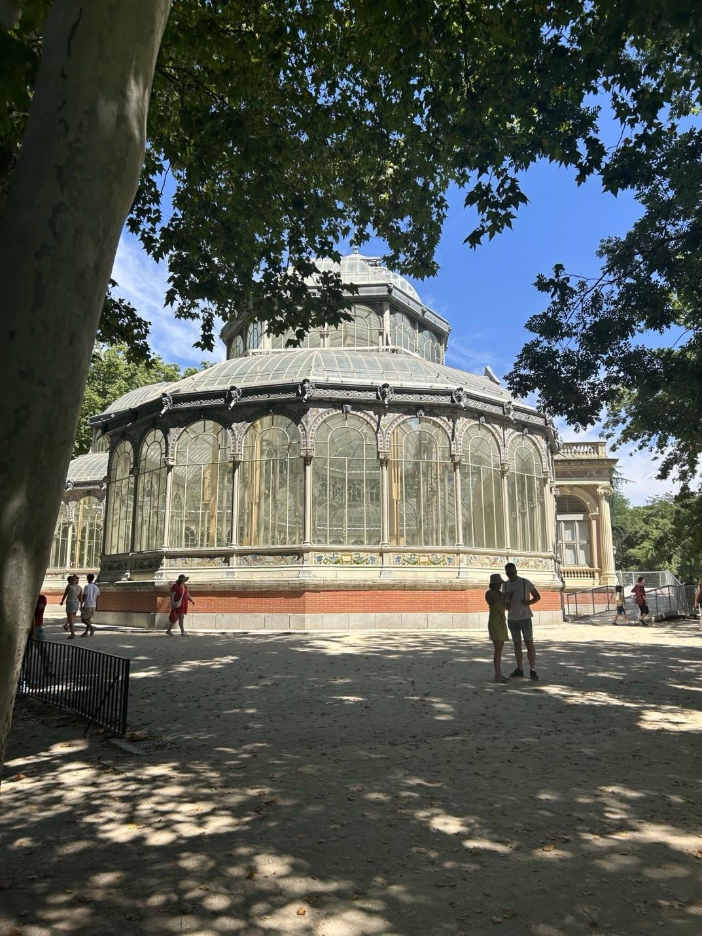
Fig. 3. El Retiro Park in Madrid, where the 1887 Exhibition was held, photo by Samantha Barnett.
Participation in the Exhibition was conceived as a competition, encouraging Native investments in the upkeep of empire and the stylized presentation of life in the Spanish colonies—Chamorros and Refaluwasch1 actively procured or created cultural objects to be displayed at the Exhibition (Pajuelo 2021, 114).
Chamorro artisans, mostly from Guam, crafted cultural belongings between 1886 and 1887 specifically for use in the Exhibition (Pajuelo 2021, 115). Spanish and Native colonial agents also collected ancestral remains and ancient tools, weapons, and cultural belongings from villages and cave sites throughout the Marianas. Many of the objects created by Chamorro artisans for the Exhibition, along with shell adzes, a bone spearhead, and slingstones dating from the Latte period (900-1695), are now held in MNA’s collections (Pajuelo 2021, 115).
The museum also currently holds nine ancestral skulls and other small bone fragments, most of which were collected by French naturalist Alfred Marche and Mariano Fausto, a Chamolinian (Chamorro and Carolinian/Refaluwasch) who was a teacher for the Carolinian community in the village of Tamuning in Guam (Gaudens, Barnett, and Gumataotao 2025, 1).
Fausto’s ability to speak Refaluwasch, Chamorro, and Spanish meant he was well positioned to serve as intermediary for the Spanish and Chamorros in their communications with the Refaluwasch, who generally could not speak Spanish or Chamorro (Gumataotao, Barnett, Gaudens 2026). Fausto’s importance to the Spanish administration, and his connections to Spanish governor Francisco Olive, allowed him to join French naturalist Alfred Marche on an expedition to the Northern Mariana Islands between May and July 1887 (Gumataotao, Barnett, Gaudens 2026).
Marche was conducting an expedition through the Marianas, funded by the French government, systematically collecting native birds, plants, and other natural history specimens, ancient Chamorro tools and cultural belongings, and human remains (Dotte-Sarout 2021, 77).
Fausto was later appointed by the Spanish administration to select objects and ancestral remains to send to the Exhibition in Madrid (Gumataotao, Barnett, Gaudens 2026).
During the visit to the Madrid and museum archives, and afterwards as I attempted to piece together an account of Fausto and his role in locating and selecting ancestral remains to be displayed at the 1887 Exhibition, I’ve grappled with how to read for Indigenous agency in colonial archives. Fausto is a slippery figure to trace; sometimes I only glimpse at shadows of a man whose actions sentenced the remains of both Chamorros and Carolinians to the depths of the museum depots. European collecting networks in colonized communities regularly relied on the assistance and knowledge of Native informants, although they are often unnamed and remain anonymous in accounts written by collectors. Archival records point to Fausto’s involvement in Marche’s expeditions, and Fausto is attributed as the “donator” of the ancestors to the 1887 Exhibition, although Marche likely did the work of unearthing the remains.
The MNA museum inventory chart definitively lists each ancestral remain in the museum’s collection, attributed as a donación from Fausto. I’ve learned that conducting provenance research and sorting through the entanglements of museum collections requires first confronting the visceral violence laid out on paper in the archive: spreadsheets listing this many skulls, cultural belongings tied to an object identification number, the stilled bodies of birds known by this scientific name. Writing on the archive of Atlantic slavery, Saidiya Hartman argues that the archive is “a death sentence, a tomb, a display of the violated body, an inventory of property” (Hartman 2008, 2). You have to first let this land in your gut before you can begin to map the terrain and conditions of dispossession.
Even as Fausto’s role in ushering our ancestors into the hands of the museum feels particularly wrenching, I recognize that empire has always required the investment of Native people who are eager to climb its ranks and benefit from this proximity to power. In Chamorro history, Fausto’s actions aren’t particularly unique, and we can look to the actions of Chamorros who actively facilitate and align with the continued dispossession and militarization of the archipelago today as a continuation of Native alliances with empire. It is evident that confronting the fact of enduring Native investments in empire adds further weight to the importance of articulating ancestral afterlives, and the politics that they insist upon. These politics genealogically tether us to our lands, waters, and ancestors, and require us to develop both a robust critique of empire and a politics of protection which is even more necessary to articulate as colonialism tightens its grip.
The circumstances of MNA collection—the fact that the ancestors were effectively “donated” for the Exhibition and willingly donated by a Native person at that—contrasts with the history of ancestors and cultural belongings in Berlin museum collections, which were clearly taken under conditions of colonial theft by a German imperial officer. Recently, as I presented the history of the MNA collection at a conference, I was met with a question from the audience that implied that we can’t make a compelling argument for the repatriation of these ancestors since they were donated to the museum. Embedded in this was a kind of “gotcha” satisfaction from the person who posed the question, as if they were happy to uncover a false grievance. This line of thinking also erases Native agency by conflating the actions of one person with legitimate community consent. Ancestral afterlives remind us of our longevity as an Indigenous people, and these politics of intimacy and responsibility outlast the violence of Fausto’s transgression. Working from our cultural frameworks and obligations, I think these ancestors would expect that over a century later, their descendants would grieve for them and fight for their return home.
In the year or so since I’ve started the work of locating our ancestors in European museums, I’ve learned that a critical part of this work rests in telling as many Chamorros about these histories as I can. When I have told other Chamorros about our ancestors that are held by these museums, I’ve seen visceral reactions of shock, grief, and anger that mirror my own emotions. Even as we work through complicated and nuanced histories or struggle through our own tensions as an archipelago as we find our ways back home to each other, I think it’s important to have these conversations out loud because they also work to communicate to our ancestors that we haven’t forgotten them. Ancestral afterlives in this sense are generative, because they ask us to take up the messy work of holding our histories and reckoning with violence, and still insist that we are deserving of care, reclamation, and futurity.
I’ve also sought to attend to how ancestors respond to the conditions of their dispossession. Hartman articulates the urge to do more than recount “the violence that deposited these traces in the archive” (Hartman 2008, 3).
As an Indigenous research method, I’ve aimed to read through colonial archives while attempting to search for and recognize the interventions of ancestral afterlives. In one account that I came across, I learned that Alfred Marche journeyed to the northern island of Rota, where he conducted excavations of ancient Chamorro latte sites (Dotte-Sarout 2021, 86).
In his account of that venture, Marche wrote that he lost “half of his Rota collections when the rowboat transporting him, his team and his collection…capsized mid-way in bad weather” (Dotte-Sarout 2021, 86).While in Rota, Marche also suffered severe bouts of malaria, and his condition worsened after the boat capsized, and he was forced to keep himself afloat in the ocean (Dotte-Sarout 2021, 87). Marche falling ill during an expedition where he raided latte sites and ancient villages is in keeping with Chamorro beliefs around the ability of spirits to cause sickness if they are shown disrespect, or if one enters their lands without asking for permission. Mochong, one of the latte sites that Marche raided, is approximately 3,000 years old and is the largest latte site in the Marianas archipelago. Attending to ancestral afterlives prompts me theorize how these ancestors could have intervened in Marche’s systematic acts of theft by causing the illness, and the weather conditions that capsized his boat and effectively stopped him from removing cultural belongings from Rota. Instead, when the boat capsized, most of the ancestral belongings were returned to the sea. Today, Rota is recognized as one of the strongholds of Chamorro language and cultural tradition, and the island was also a place of refuge for Chamorros who fought against and hid from the Spanish during the Spanish-Chamorro Wars.
Following Hartman, I analyze these archival accounts to read for the interventions of ancestral afterlives in colonial collecting practices by writing with and against the archive. In this sense, I apply Chamorro practices of seeing the dead and forms of communication from our ancestors to archival accounts in order to examine how ancestral afterlives haunted empire by intervening in their ongoing dispossession—overturning boats carrying stolen belongings, causing illness, and later by speaking to their descendants to orchestrate their return home. This disciplined reading with and against the archive moves beyond merely tracing lines of violence and allows me to witness how our ancestors speak back.
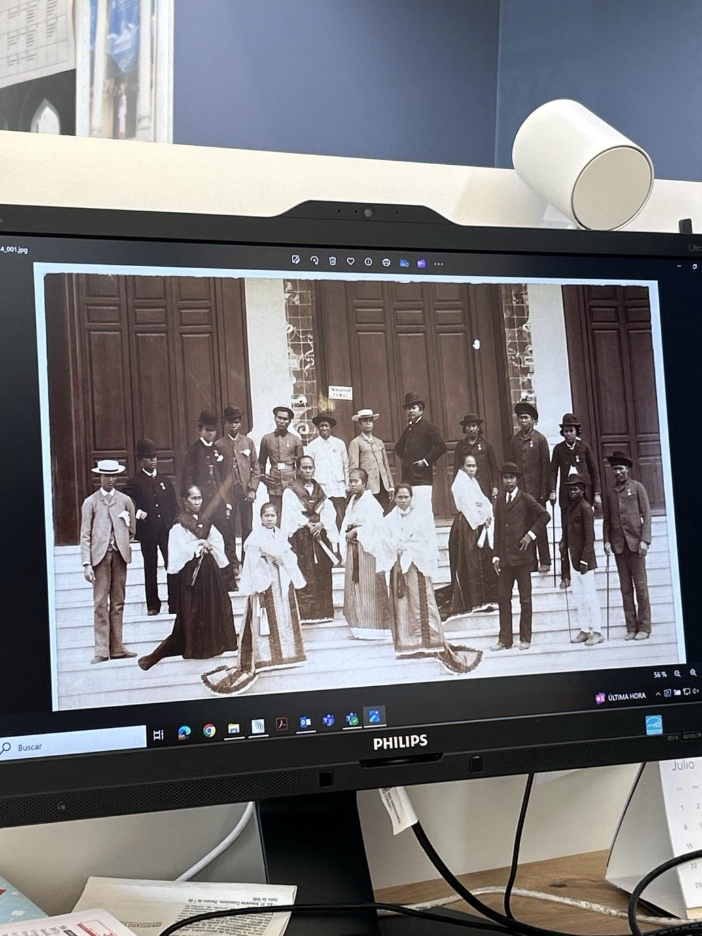
Next, I turn to examining the stories of the people from the Marianas who traveled to Madrid to participate in the Exhibition. One of the most striking moments of the archival visit was encountering a photograph of the Indigenous participants at the Madrid Exhibition. Looking at the photograph, we tried to locate the Chamorro participants, searching for ourselves in their gaze, in the angle of their cheekbones. In the monograph To Be Nsala’s Daughter: Decomposing the Colonial Gaze, Chérie N. Rivers examines colonial-era photography in the Congo by missionary Alice Seely Harris, tracing the mechanics of the colonial gaze and attending to how to develop a practice of “decomposing the colonial gaze” (Rivers 2023, 16).
In this context, Rivers articulates the colonial gaze as both a stance and logic of invisible power (Rivers 2023, 15). Examining a photograph taken by Harris, Rivers writes: “From this perspective, this is not a photograph of a native woman but a photograph of power, a record of domination that distorts as much as it documents” (Rivers 2023, 15)
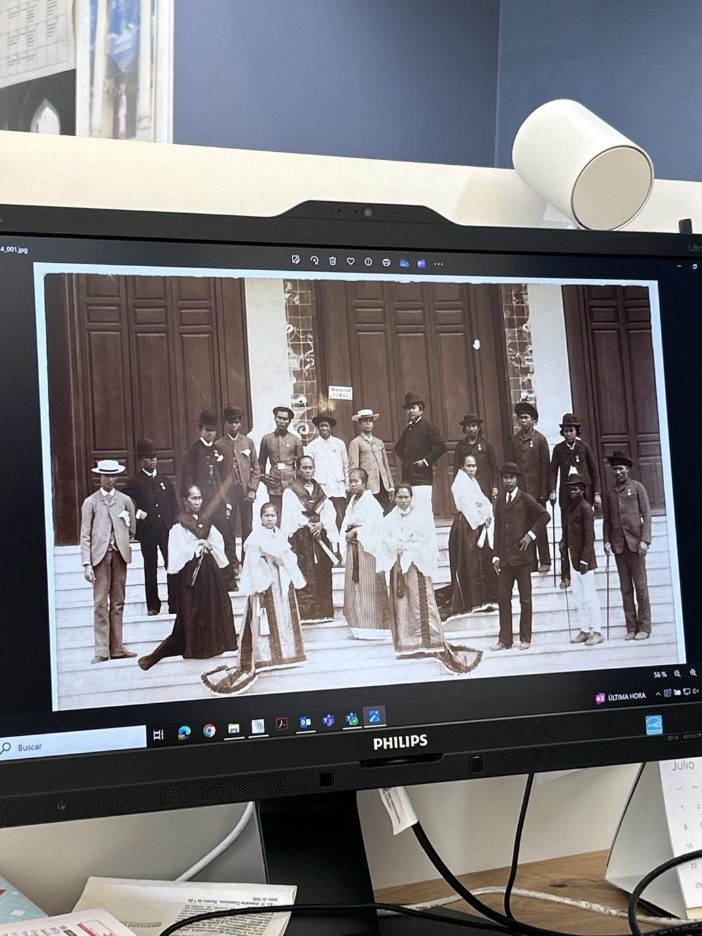
Fig. 4. Accessing the archival shot of Indigenous participants at the 1887 Exhibition, photo by Samantha Barnett.
Analyzing the archives of the 1887 Exhibition as a record of power that documents as much as it distorts provides an apt framework for reckoning with an exhibition that displayed both plundered ancestral remains and living Chamorros and Refaluwasch, who were posed in colonial dress to pay homage to the Spanish queen regent (Miyagi 1975, 31). The fact that the 1887 Exhibition posed living Chamorros and Refaluwasch as part of an exhibition that also displayed their dismembered ancestors demonstrates the intimacy of the colonial grip on Native bodies, and suggests that the Exhibition more accurately reveals the stance and logic of the colonial gaze than any proposed ethnographic insight on Micronesia.
The afterlife of the Exhibition, which displayed both the living and the dead from the Marianas and the Caroline Islands, funneled cultural belongings and ancestors into the MNA depots.
While they are not identified in any photographs, the archives do give us the names of the four Micronesians who were contracted to participate in the Exhibition (Miyagi 1975, 31). There were two Chamorros from Guam—Jose Flores, 22, and Antonia Santos Leon Guerrero, also 22, and two Refaluwasch—Luis Pe-aripis, 32, and Dolores Neisern, 22 (Miyagi 1975, 31). Little is written about their experiences at the Exhibition; accounts note that Flores was a talented musician and participants were impressed with his wit and intelligence (Miyagi 1975, 32). What must it have been like for these young Chamorros and Refaluwasch to voyage to Madrid —what did they make of their surroundings, and of the spectacle of the Exhibition?
Bedridden with fever, Dolores Neisern missed the Exhibition opening day ceremonies (Miyagi 1975, 31). Throughout her illness, Neisern was cared for by Antonia Santos Leon Guerrero (Miyagi 1975, 32). It’s easy to imagine these young women, who were perhaps initially excited by the opportunity to travel and serve as representatives of their islands and people, struggling in isolation from their families as one suffered from sickness and the other sought to give her refuge. Neisern and Luis Pe-aripis both died in Madrid, and did not return home (Miyagi 1975, 32). Like the ancestors that Fausto ushered into the hands of the museum, Neisern and Pe-aripis’s lives were also claimed by the Exhibition’s fixation on spectacle and death.
The afterlives of the exhibition compelled our visit to MNA in July 2024, where a curator led Andrew and me through the collections and the museum’s archives. It was during this visit that we were again led to a storage room in some forgotten corridor of the museum where we encountered our ancestors. We prayed over them and Andrew kneeled in front of an ancestor who was taken from a cave in Pigo, in the village of Hagåtña—the same village where his family has lived for as far back as they can remember. The juxtaposition of ancestor and descendant, both taotao Hagåtña, struck me as a kind of reclamation between this ancestor and our homeland. The Chamorro creation story teaches us that our people were born from the land, thus we carry the landscapes of our villages and genealogies within us. Even some of the names of villages in Guåhan correspond with body parts—for example, the central village of Barrigada comes from the Chamorro word for flank, or the side of the stomach. These histories root us in our lands, and the reunion of ancestor and descendant is a way to bring healing to these ancestors, by also reuniting them with the village.
In initial discussions with MNA, they advised us that while Spain has not carried out many repatriations thus far, the museum supports the repatriation and future collaborations. The decision regarding repatriation of ancestral remains is ultimately not made by the museum, but by the Spanish government. The MNA staff advised that the current political administration is progressive and would be more receptive than past administrations. We worked with Spanish graduate student researcher Alba Ferrandiz Gaudens, who has extensively researched the 1887 Exhibition and provided assistance with Spanish language archives, to compile a report on the ancestors at MNA, which was shared with the museums and historic preservation offices in Guam and the Northern Mariana Islands. These discussions are ongoing.
In the meantime, as we wait for formal repatriation, there is important rematriation work and reclamations that we have a responsibility to enact. This rematriation work includes reuniting ancestor with descendant, and caring for them with prayer, chant, and ceremony. While we were at MNA, the museum staff asked if we had any recommendations on how these ancestors should be cared for. Until they are able to return to their home islands, we requested that these ancestors be kept together. We also requested that a spear, carved from human bone, that was being stored with cultural belongings to instead be recognized as an ancestor and kept with the skulls. The museum staff confirmed that they followed both requests. These kinds of Indigenous interventions within the museum are critical expressions of rematriation work.
Conclusion
In conclusion, navigating museum processes as community members and researchers is far from simple. Yet, we remain motivated by the understanding that museums can be enlivened and made meaningful through Indigenous and community-led engagement. Communities embody living knowledge systems when relationship with ancestors and cultural heritage, generating dynamic and transformative experiences within museums. These processes contribute to broader efforts of reclamation, which are deeply interconnected with rematriation and Indigenous nationhood. While museums have made progress in collaborating with communities, our work highlights that the inquiry and engagement processes of museum practice require continued reflection and reimagining.
Rematriation offers a pathway toward the future—one that insists on life, honors our ancestors, and restores vitality to collections and ancestors that are otherwise silenced. Through this process, we bring life back into these histories, reaffirming connection, and continuity for generations to come.
-
Indigenous Micronesians from the Caroline Islands, namely Chuuk and Yap. ↩